Most beginners come to karate believing that a technique ends when it hits something.
This is not an unreasonable assumption. Hitting things is noisy. It produces feedback. Pads pop, bags sway, partners grunt politely. Noise has a way of convincing us that something important just happened.
Unfortunately, karate does not measure importance by volume.
In traditional karate, a technique does not end at contact. It ends at arrival. The two moments are related, but they are not the same thing, and confusing them leads to a great deal of unnecessary flailing.
One of my favourite ways to explain this—whether I stole it from someone wiser or accidentally said something useful myself—is this:
The fist does not arrive with a crash; the fist arrives after the crash.
That sentence tends to sit with students for a while, mostly because it sounds simple and then refuses to be.
Every technique in karate, whether it is a block, a strike, or a kick, has a beginning and an ending that matter just as much as the middle. The hips and the technique must leave the body at the same time. Not the hips first with the arm scrambling to catch up, and not the arm firing off while the hips remember their responsibilities slightly too late. Together. Always together.
The same rule applies at the other end. The hips and the technique must arrive at the same time. This is where most people get distracted, because somewhere along the path, something gets hit, and the brain decides the job is finished. The body, however, has not agreed to this arrangement.
Impact is an event. Arrival is a conclusion.
Contact can happen anywhere along the path of a technique. A punch might land early. A block might intercept halfway through. A kick might meet resistance long before full extension. None of this is a problem. The problem begins when the technique stops thinking because it touched something.
The crash is contact. Arrival is what happens after—when posture settles, balance resolves, breath finishes, and the body is no longer searching for where it ought to be.
A punch that lands but leaves the body drifting forward, leaning, or collapsing has not arrived. It merely visited.
You can see this clearly in basic techniques. Take a simple straight punch. A common beginner version involves the arm firing out, the hips snapping late, the fist making contact, and the body continuing to wander forward like it missed a step. The punch hit. The punch did not finish.
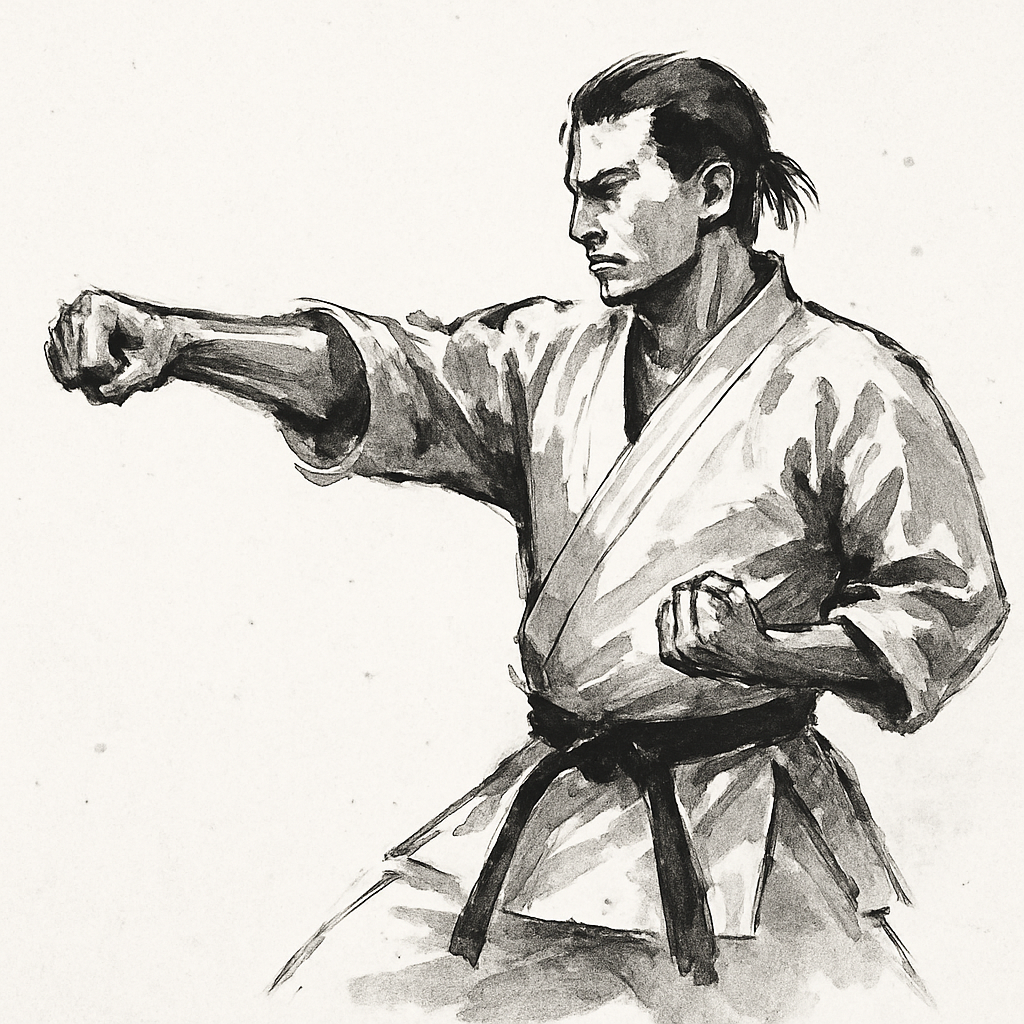
A proper punch leaves the body as a unit. The hips and fist move together, the stance supports the motion, and when the punch arrives, everything else has already made its peace with where it is. The punch may have connected halfway through the motion, but the body completes the technique regardless of the target’s cooperation.
Blocks suffer from the same misunderstanding, often worse. Many students treat blocks as emergency reactions—something you swing into danger and hope for the best. But a block is not a flinch. It is a technique with a beginning, a path, and an end. If the block intercepts the attack early, good. If it meets resistance halfway, also fine. But the block must still finish where it was designed to finish, with the hips settled and the body stable. A block that stops an attack but leaves you twisted, leaning, or overcommitted has solved one problem and created the next.
Kicks, of course, are where this lesson becomes impossible to ignore. A kick that hits but dumps the kicker off balance is not powerful; it is optimistic. Proper kicks lift from the hips, extend under control, and return the body to stability. The foot touching something is incidental. The kick ends when the body is ready to move again, not when the leg runs out of enthusiasm.
None of this is new. Traditional Okinawan karate was developed by people who did not expect clean, cooperative exchanges. Teachers such as Chōki Motobu were openly critical of techniques that looked impressive but left the practitioner compromised afterward. Stability after action mattered because the next moment was never guaranteed to be polite.
Chitō-ryū’s emphasis on posture, alignment, and full completion of movement reflects the same thinking. Techniques were meant to resolve with structure intact, ready for whatever followed—or ready to not move at all, which is also a decision.
For beginners, this can feel like an unnecessary complication. It is tempting to rush to the interesting part of a technique, to chase the sound and the sensation of contact. But karate rewards patience. Learning to leave together and arrive together builds habits that quietly improve everything else. Techniques become stronger without trying harder. Balance improves without conscious correction. Zanshin stops being a word and starts being a physical state.
If there is a single thing to remember, it is this: if your body is still sorting itself out after your technique, the technique is not finished.
Or, put another way:
The fist does not arrive with a crash; the fist arrives after the crash.
Train for arrival. The noise will take care of itself.